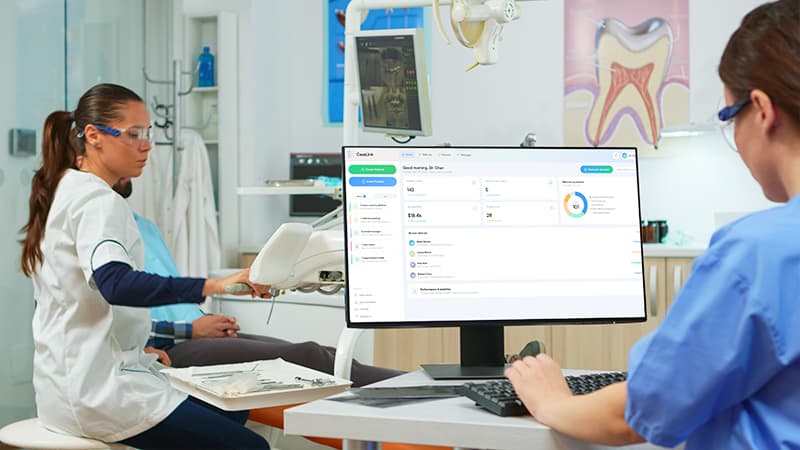
Endodontists depend on GP referrals for most new patients. A referral platform gives the practice visibility from intake through treatment.
An endodontist does not fill a schedule from walk-ins. The overwhelming majority of those chairs are booked by a decision made in someone else's office, a GP deciding to refer, that the endodontist never sees happen. The practice lives or dies on referrals it does not control and often cannot even count.
A mid-size endo practice takes in 80 to 120 referrals a month from area GPs. They arrive in every format imaginable. Some by fax, a name and a tooth number. Some by phone, relayed front desk to front desk. A few by email, occasionally with an X-ray riding along on an unsecured message. And a handful still walk in as paper slips the patient was told to bring.
When the referral process breaks, the schedule breaks. For an endodontist, referral management is not administrative housekeeping. It is the pipeline.
The specialist's referral problem is its own thing
General dentists send referrals and care whether the patient got treated. Specialists receive them and care about volume, conversion, and the quality of the clinical context that shows up with each case. Different job, different questions.
For an endodontist, the daily questions are specific. How many referrals came in this week, and from which GPs? How many of those patients actually called? How many consults got booked versus how many went silent? Of the ones who completed treatment, which GP sent them?
Most endo practices cannot answer any of that without counting by hand. The front desk tallies faxes. Someone cross-references the schedule against a referral log. Attribution back to the referring GP depends on memory or a spreadsheet that may already be out of date. Cases get treated and patients get seen, but the practice runs half-blind to where its work comes from and where it leaks.
What referral management actually does for an endo practice

A referral platform is a layer between the GP who sends and the endodontist who receives. It does not replace the clinical system. TDO, Dentrix, DentalEMR, and the rest handle charting, imaging, and billing. The platform handles the handoff.
For an endodontist, that means a few concrete things.
Structured intake. Every referral arrives in one format. Patient identifiers, tooth number, reason for referral, images, and the GP's notes. No more decoding a fax that may or may not include the radiograph you need.
Stage tracking both sides can see. The case moves through defined stages from received to contacted to scheduled to completed to a treatment decision. The GP and the specialist read the same timeline.
Source attribution. The practice can see exactly how many referrals came from each GP over any period, which ones convert, and which relationships are worth a lunch-and-learn or a study club invite.
Secure messaging. When you need a cleaner radiograph or a note on a prior restoration, the request goes through a secure channel attached to the case. The GP's front desk answers in context, no phone call required.
Follow-up that surfaces itself. A case with no patient response after a set window comes back up for outreach, without a separate reminder system to maintain.
The revenue math
Root canal therapy runs roughly $1,500 to $3,500 per case depending on the tooth, the complexity, and the payer mix. Use a $2,500 midpoint and the numbers get direct fast.
A practice taking 100 referrals a month and losing 30 to the gap between referred and seated is leaving about $75,000 a month on the table. Over a year, close to $900,000. You will not recover all of it. You do not need to. Five additional cases a month at $2,500 is $150,000 a year in production, a full operatory's worth, pulled from referral relationships you already have rather than from new GP outreach.
A platform at $299 a month runs $3,588 a year. One recovered case covers it several times over, and you are aiming for far more than one.
How CaseLink works for endodontists
CaseLink is a HIPAA aligned referral and collaboration platform for dental practices. It connects GPs and specialists around a shared case record.
The workflow starts when a GP creates a referral. The case lands in the specialist's inbox with patient information, the clinical reason, and any attached files. The front desk accepts it, and the case enters a six-stage pipeline: Referral Received, Patient Outreach, Consultation Scheduled, Consultation Completed, Treatment Accepted, and Treatment Declined or Archived. When the patient books, the GP's office sees it without a phone call. When treatment is accepted, the loop closes for both offices.
CaseLink runs in the browser at app.caselink.net, so there is nothing to install. It works alongside whatever clinical system you already use, TDO or Dentrix or anything else. Referral coordination lives in CaseLink. Charting, imaging, and billing stay put.
For the GP side, CaseLink is free, which matters because the network only works if GPs are sending through it. There is no cost barrier to getting referring offices on board. The endodontist pays $299 a month, with 10 percent off annual billing.
The strongest endo practices share one trait: a reliable set of GPs who send cases consistently.
The network is the asset
The strongest endo practices share one trait: a reliable set of GPs who send cases consistently. Those relationships take years to build through clinical trust, proximity, and dependable communication.
A platform does not create the relationships. It makes them legible. When you can see that Dr. Mercer's office sent 14 referrals last quarter and 12 converted, while Dr. Pratt sent 8 and 2 converted, you have something to act on. The front desk follows up differently. You invest your attention differently. Referral management stops being a clerical task and becomes a strategic one. The schedule fills because the practice finally knows where its cases come from.
Frequently asked questions
Do I need to replace my practice management system?
No. A referral platform handles the handoff between offices. Charting, imaging, and billing stay in the system you already use. CaseLink works alongside TDO, Dentrix, Eaglesoft, Open Dental, and others.
How do I get my referring GPs to use it?
CaseLink is free for general dentists. No trial, no card, no feature limit on sending referrals. Inviting a GP takes under a minute from the referral screen. Most adopt because it cuts their phone follow-up.
Is the platform HIPAA aligned?
Yes. End-to-end encryption and audit logs for all case activity. Business Associate Agreements are available to subscribed specialist practices.
Can my front desk manage referrals without me?
Yes. CaseLink is built for office managers and front desk teams. Staff can accept referrals, update status, message referring offices, and run the pipeline without clinical involvement in the administrative steps.
What if a referring GP is not on CaseLink yet?
Invite them from the platform. They get an email, create a free account, and can send referrals right away.
How do I track which GPs send the most?
CaseLink reports on referral volume, source attribution, and completion by referring practice over any time period.